Faster Qwen-Image-Edit 2511 by caching KV
Qwen-Image-Edit-2511 edits an image by concatenating the input image’s VAE-encoded latent tokens onto the noisy target latent, and running the concatenation through 60 joint self-attention blocks, once per denoising step. The reference tokens’ own output gets thrown away every single step — only the target (noisy) tokens get decoded into the final image. That’s a strong hint that the reference tokens’ contribution to attention might be far more stable across steps than the target’s, and that recomputing it from scratch 60 times over might be mostly wasted work. This post is the study that checks that hunch, the cache that exploits it, and the eval that says whether it’s actually worth it. Code’s on GitHub; built in conversation with Claude.
The architecture, in one diagram
Qwen-Image-Edit-2511 is a dual-stream MMDiT: separate weights per block for the image and
text streams, but joint self-attention — everything attends to everything in one
scaled_dot_product_attention call. The image stream itself is a concatenation of two
different kinds of tokens sharing the same img_in projection and the same 60 blocks:
- target tokens — the noisy latent actually being denoised into the output image.
- reference tokens — the VAE-encoded input image, there purely as conditioning.
The pipeline slices the transformer’s output back down to just the target portion
(noise_pred = noise_pred[:, :latents.size(1)]) before every scheduler step. The reference
tokens’ own output row is computed and immediately discarded, every block, every step.
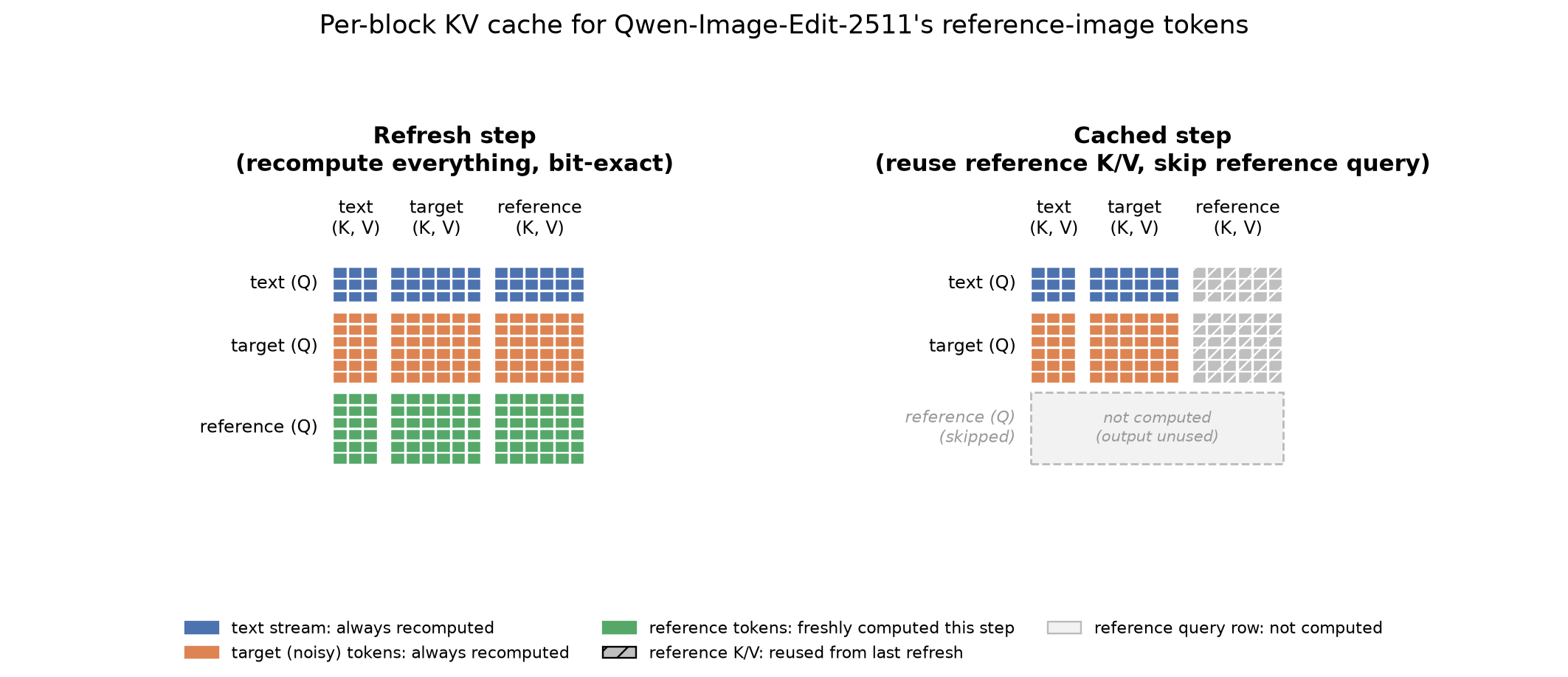
That’s the mechanism this whole post exploits: if a “cached” step can reuse the reference tokens’ Key/Value from a prior step instead of recomputing them, it can also skip computing the reference query row entirely — its output was never going to be used anyway. The saving isn’t just “skip a linear projection”; it shrinks the actual attention computation (shorter query dimension) and skips the reference tokens’ own MLP/residual update on that step.
The open question is whether that reuse is actually safe — i.e., how much does the reference tokens’ Q/K/V actually drift, step to step, at a given block?
Study: how stable are the reference tokens, really?
Mirroring an earlier internal methodology (a similar KV-cache-viability study on a
different image-editing DiT), I hooked attn.to_q / attn.to_k / attn.to_v on all 60
QwenImageTransformerBlocks, ran 5 real images through the full 50-step schedule
(cfg=1.0, so exactly one forward pass per step), and for each block computed cosine
similarity between the reference tokens’ Q/K/V at step i and step i+gap, for every valid
gap from 1 to 49.
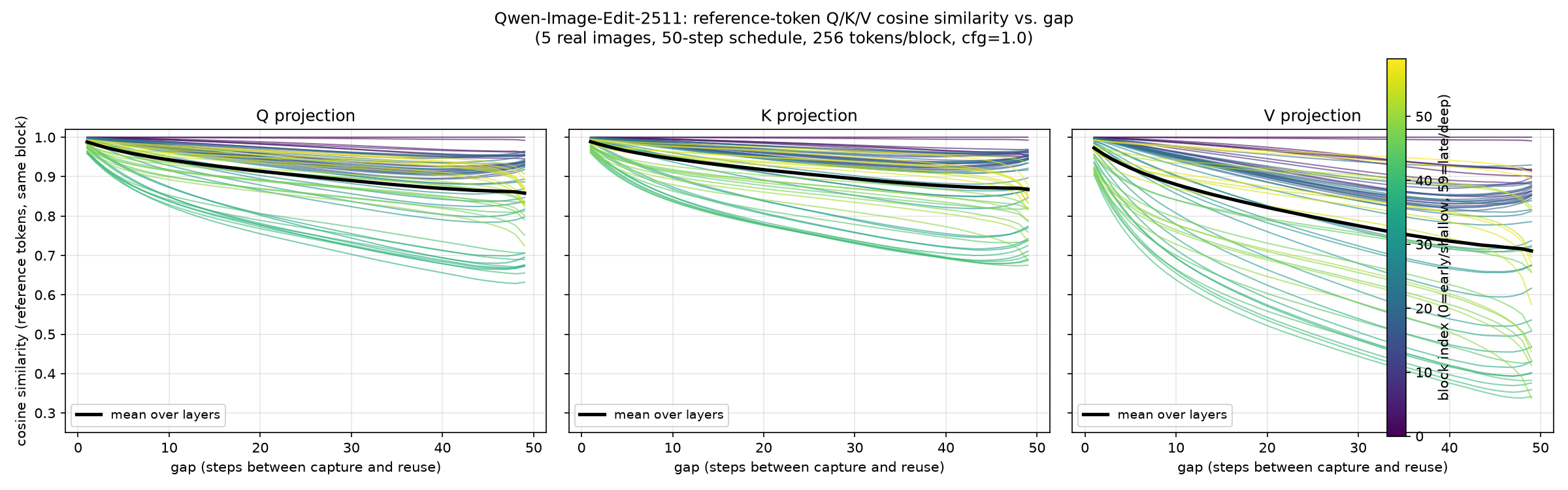
The finding surprised me: block 0 is provably frozen — cosine similarity of exactly
1.0 at every single gap, for every image, for Q, K, and V. That’s not noise; it falls out of
the architecture directly. Qwen-Image-Edit uses a zero_cond_t mechanism: the reference
tokens always get AdaLN modulation from a fixed zero-timestep embedding (never the real,
per-step timestep), and at block 0 specifically there’s been zero prior cross-attention with
the (evolving) target tokens yet. Both the input and the modulation applied to it are
step-invariant, so the output is too.
That stability doesn’t last, though. As you go deeper, each block’s joint attention lets a little bit of target-token information leak into the reference tokens’ residual stream, and it compounds:
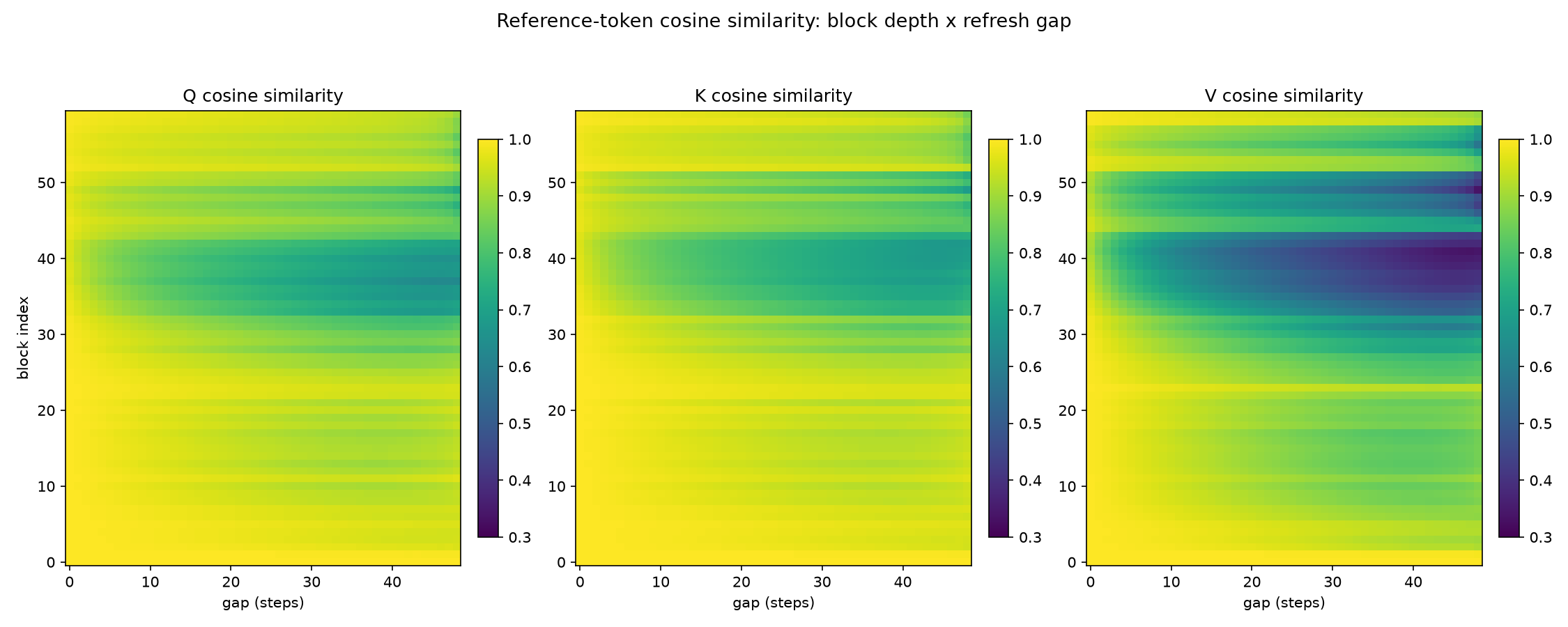
The heatmap makes the shape obvious: a U-shaped stability curve across depth, not the monotonic or uniform decay I’d expected. Blocks ~1-25 and ~50-59 stay highly similar even at the largest gap tested (0.86-0.96 for Q/K, 0.91+ for V), while blocks ~26-49 are a genuinely volatile middle band — down to 0.63-0.70 for Q/K and as low as 0.34 for V at gap=49.
That non-uniformity is the whole design constraint for what comes next: a single global cache-refresh-cadence (cache every block the same way) is the wrong shape for this model. It would either refresh often enough to protect the volatile middle band and waste most of the savings available in the ~45 stable blocks, or refresh rarely enough to get real speedup and eat real error specifically in that middle band.
Implementation: a per-block cache
qwen_kv_cache.py monkeypatches each block’s forward pass with a schedule-driven choice
between two paths:
- Refresh step: call the block’s real, unmodified forward (bit-exact), and separately — redundantly, but safely — recompute just the reference tokens’ post-RoPE K/V to stash for later.
- Cached step: run
to_q/to_k/to_vand the FFN on the target tokens only, reuse the stashed reference K/V for the joint attention’s key/value, and skip the reference query row and its residual update entirely (the reference hidden state stays frozen until the next refresh).
The refresh schedule is per-block, not global — an array of refresh_every[block_id]
values, so the frozen/stable bands (block 0, 1-25, 50-59) can go many steps between
refreshes while the volatile middle band (26-49) refreshes every step.
Getting this correct took two real bugs, both caught by insisting on bit-exact validation before trusting any speedup number:
QwenImageTransformerBlock.forwardreturns(encoder_hidden_states, hidden_states)— text stream first. I had the tuple backwards.- The joint attention processor applies an output projection
(
attn.to_out[0],attn.to_add_out) after the attention and before the residual add. I’d missed it entirely — the cached path produced pure noise even when fed the correct, non-stale reference K/V, because the output was never projected back into the right basis.
The gate that catches regressions like this: force every block to refresh every step
(RefreshSchedule.uniform(60, 1)) and diff against the true unpatched model. That
configuration is 100% pixel-identical to baseline — only once that held did I trust any
result from an actual caching schedule.
Eval: does it actually pay off?
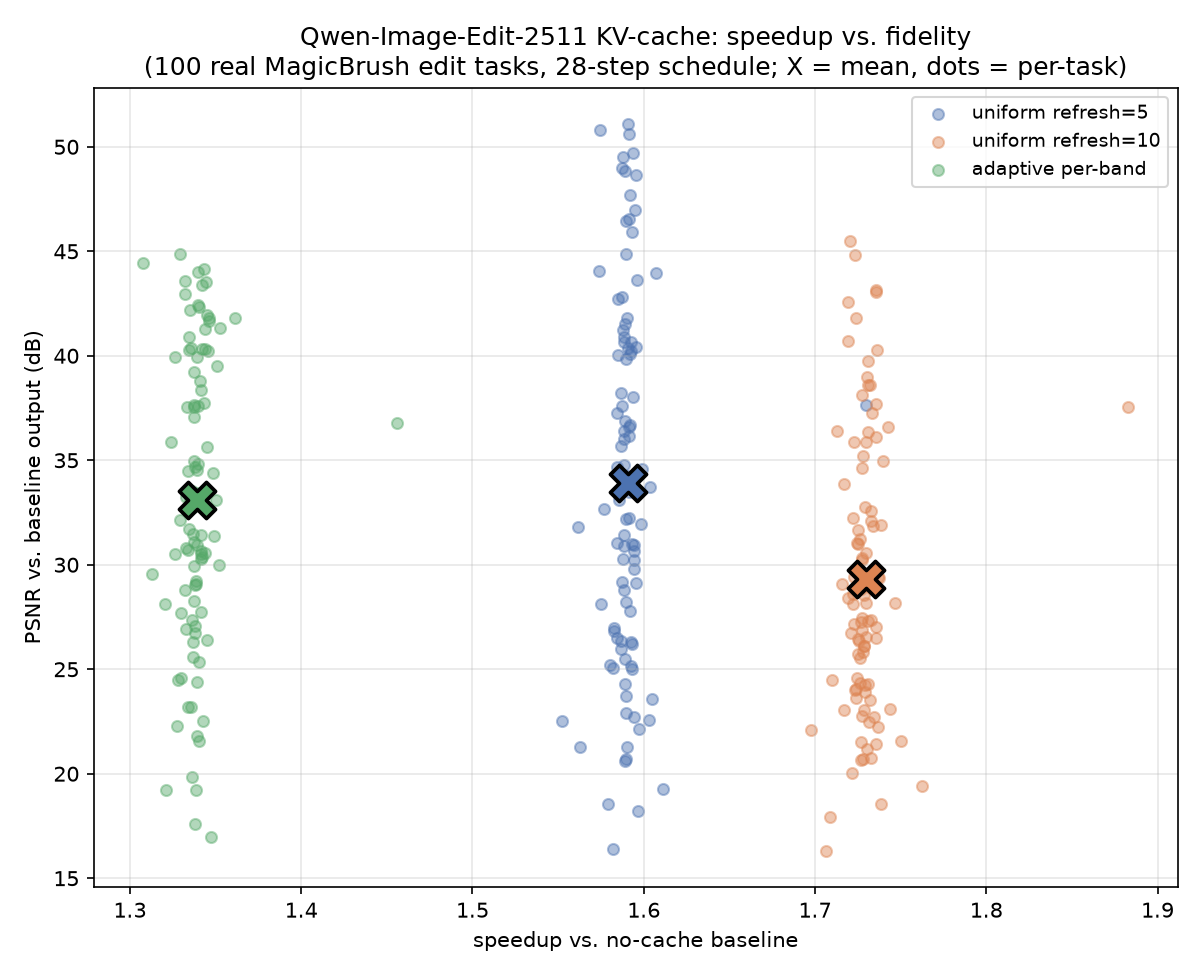
Ran 100 real (image, instruction) pairs sampled from
MagicBrush — its own held-out
human-verified eval split plus a random top-up — through four conditions at 28 steps: a
true no-cache baseline, two global schedules (uniform_5: refresh every 5 steps;
uniform_10: every 10), and the depth-aware adaptive schedule the study above motivated
(block 0 cached forever, blocks 1-25/50-59 refresh every 10 steps, blocks 26-49 never
cached).
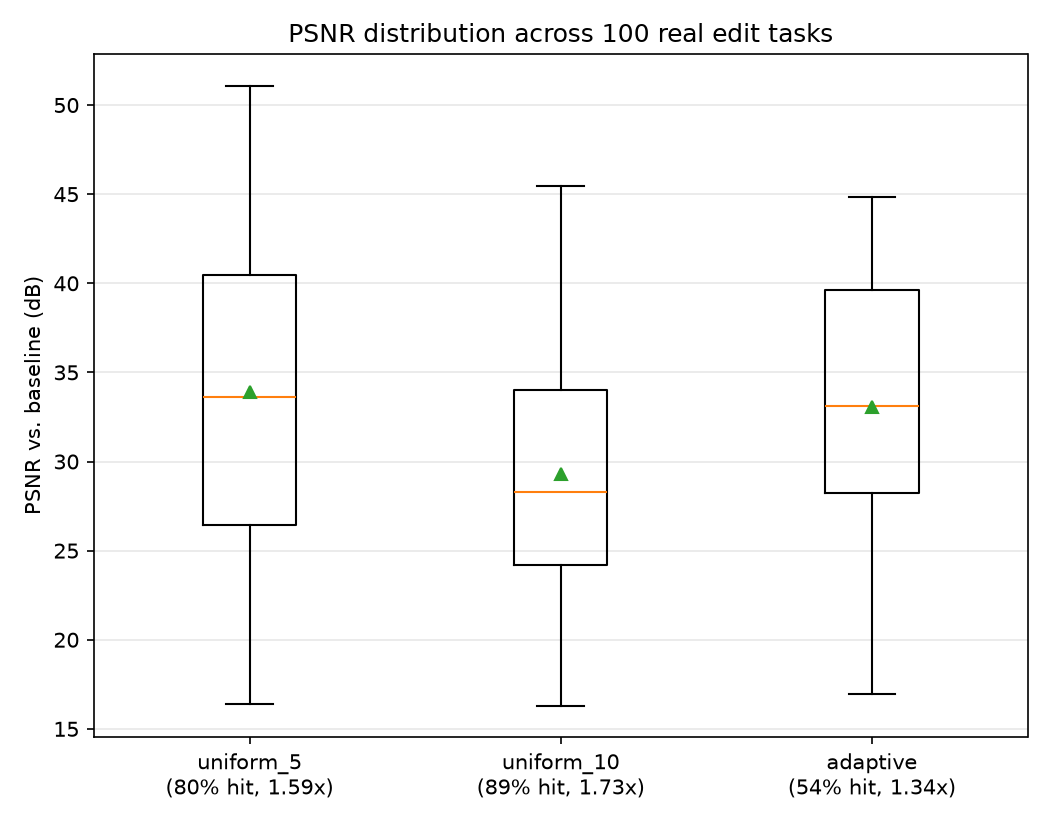
| scheme | speedup | avg PSNR | median PSNR | worst-case tail (p10) | hit rate |
|---|---|---|---|---|---|
| uniform, refresh=5 | 1.59x | 33.9 dB | 33.7 dB | 22.6 dB | 80% |
| uniform, refresh=10 | 1.73x | 29.3 dB | 28.4 dB | 21.5 dB | 89% |
| adaptive per-band | 1.34x | 33.1 dB | 33.2 dB | 23.2 dB | 54% |
uniform_10 is dominated outright — fastest, but worst on quality by every measure.
Between uniform_5 and adaptive, the interesting result is that they land at nearly the
same average PSNR — a smaller pilot on 5 hand-picked images had suggested adaptive would
be a clean winner on quality at every speed point, and that gap mostly closed at 100-image
scale on a more realistic, diverse task mix. What survives is the distribution:
adaptive’s PSNR spread is visibly tighter (boxplot IQR ~11.4 dB vs. ~13.9 dB) and its
worst-case tail is a little better — it’s the more predictable choice, at the cost of being
~19% slower.
On typical edits, both the cache and the baseline land in essentially the same place:
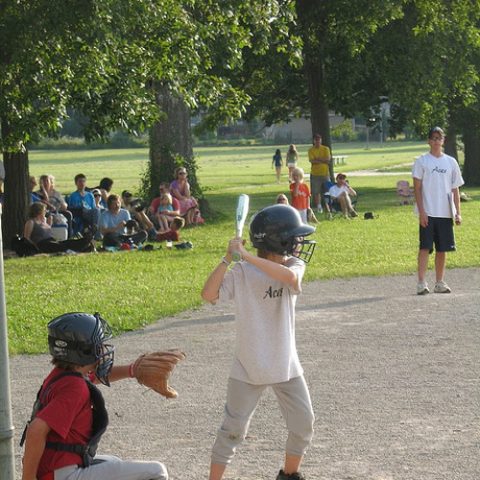
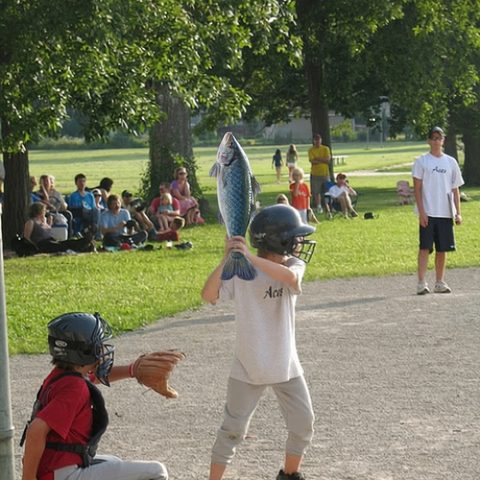
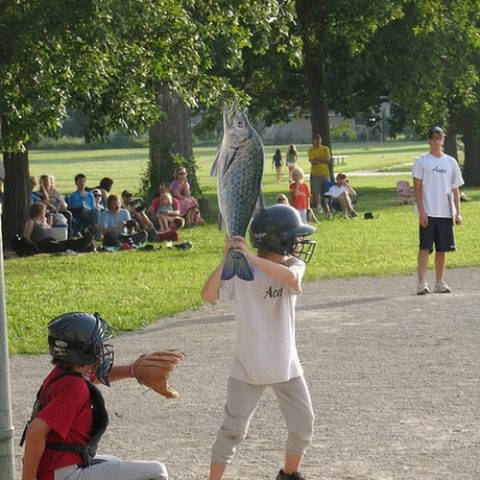
"Change the baseball bat to a big fish" — nearly indistinguishable.
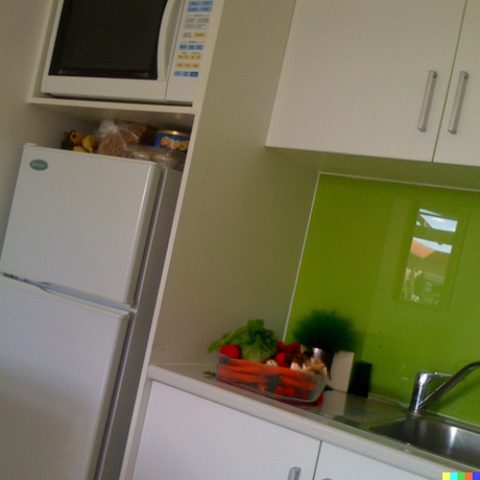
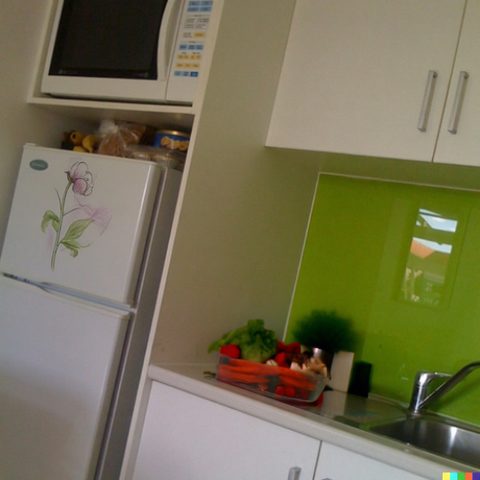
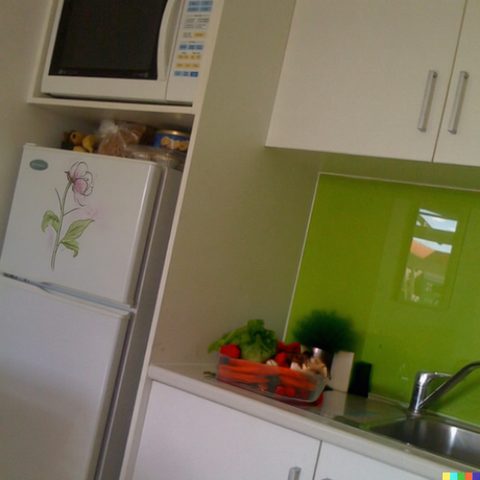
"Let's add a drawing of a flower to the fridge" — again, essentially the same result.
But the single worst PSNR score in the whole 100-image run (16.4 dB) is worth looking at directly, because it’s a useful warning about the metric itself:
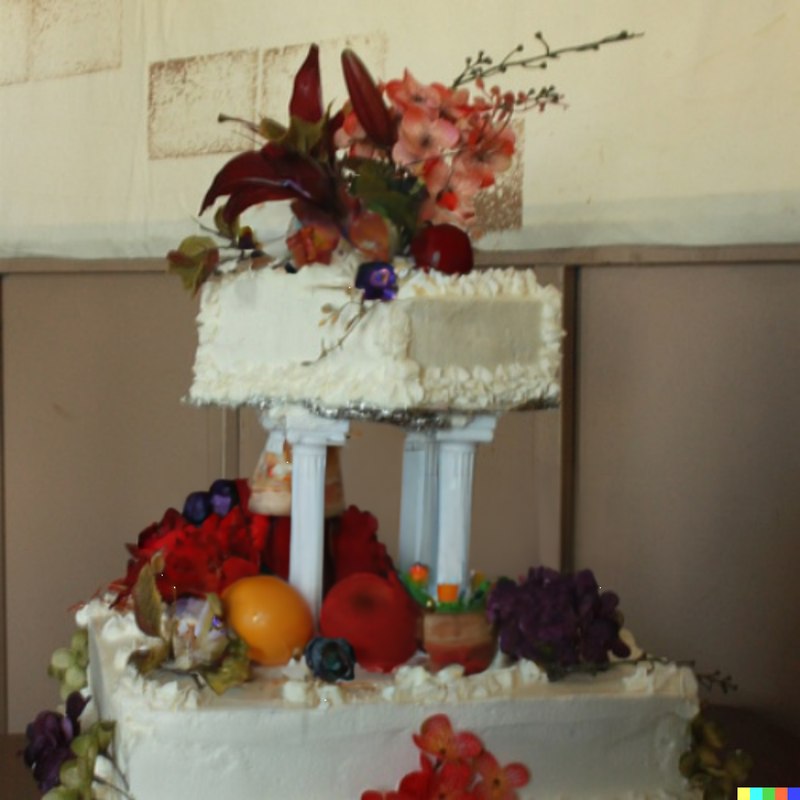
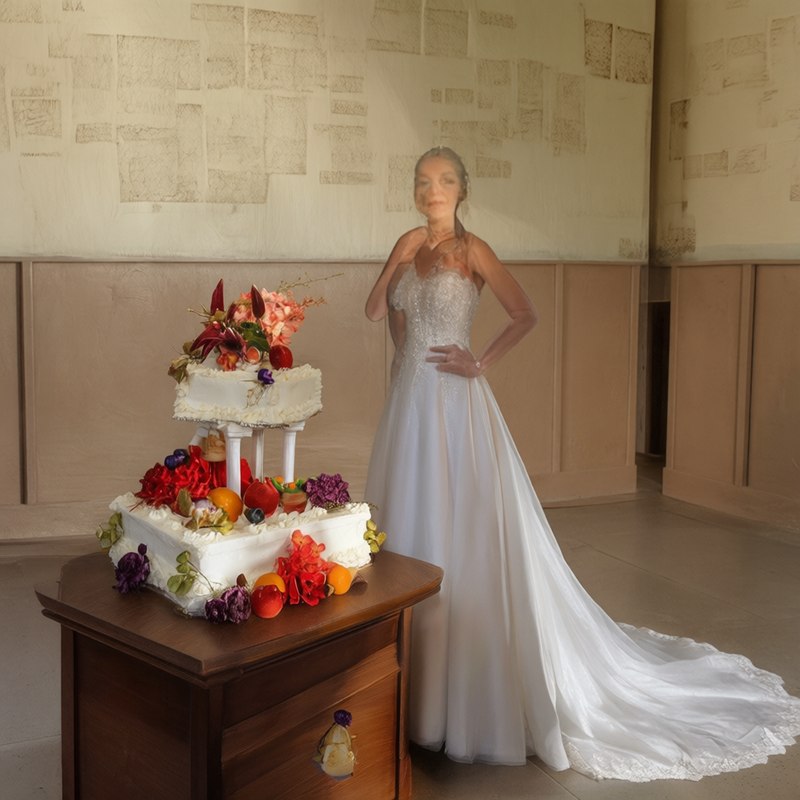
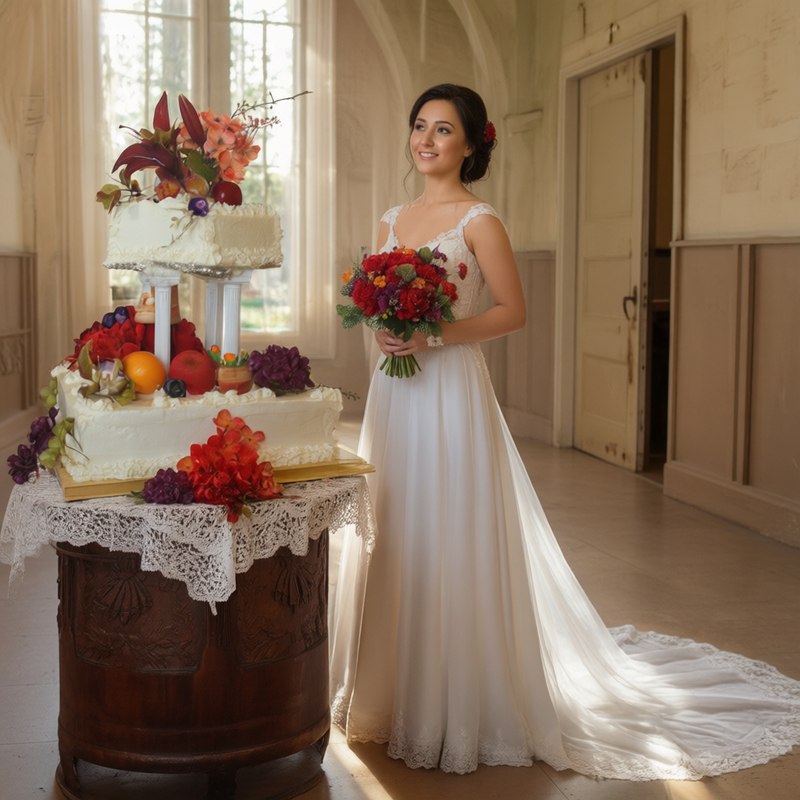
"Let a woman in a bridal gown stand near the cake" — PSNR says this is the worst result in the whole run. Look at it: the cached version is arguably better than the baseline, which has a visible ghosting/transparency artifact on the inserted figure.
For an instruction this generative — inserting a whole new subject into the scene — the model has a wide space of equally-valid outputs, and caching just nudges which one you land on. Low PSNR-vs-baseline mostly reflects “different point in the output distribution,” not “quality collapsed.” It’s a fine relative signal for comparing caching schemes against each other, but not a substitute for actually looking at the images, especially for content-adding edits rather than style/color changes.
Where this leaves things
- The reference-token KV cache is a real, “free” speedup — no retraining, and the only error source is the model’s own token drift, not anything introduced on purpose.
- The depth-aware schedule is worth the extra complexity if predictability matters more than raw throughput; a blind uniform schedule is worth it if the reverse is true.
- This is a research prototype, monkeypatched onto a standalone
diffusersinstall, tested at one resolution regime on 100 images on a single H100. Sensitivity to resolution/aspect ratio (which mattered a lot in an earlier internal cache study) is still open.
Everything — the study script, the cache, both eval harnesses, the benchmark builder, and the raw results — is on GitHub.
Citation
Please cite this work as:
Subkhankulov, Marat. “Faster Qwen-Image-Edit 2511 by caching KV”. submarat.github.io (Jul 2026). https://submarat.github.io/accelerating-up-qwen-image-edit-2511-by-caching-kv/
Or use the BibTeX citation:
@article{subkhankulov2026fasterqwen,
  title   = {Faster Qwen-Image-Edit 2511 by caching KV},
  author  = {Subkhankulov, Marat},
  journal = {submarat.github.io},
  year    = {2026},
  month   = {July},
  url     = "https://submarat.github.io/accelerating-up-qwen-image-edit-2511-by-caching-kv/"
}