Training an SAE on GPT-2, and steering it into gibberish on purpose
In the last post I built the boring-but-necessary plumbing: 30M residual-stream activations from gpt2-xl at blocks.7.hook_resid_post, packed into shards on disk. This post is the payoff — training a sparse autoencoder on those vectors and then doing the thing that makes interpretability feel real: finding a feature by what it correlates with, then causally forcing it and watching the model obey. The code for both stages is on GitHub. As before, this was worked out with Claude alongside me.
Why an SAE, and why TopK
The residual stream is dense and polysemantic: any single neuron participates in many unrelated computations, so you can’t read a direction off it and say “this is the X feature.” The sparse-autoencoder bet is that those activations are secretly a sparse combination of many more interpretable directions than there are dimensions — so you train an overcomplete autoencoder that reconstructs each activation using only a handful of active latents, and hope those latents are monosemantic.
I used a TopK SAE (the Gao et al. / OpenAI recipe): the encoder produces a pre-activation per latent, you keep only the top k and zero the rest, and the decoder reconstructs from those. The appeal is that there’s no L1 sparsity coefficient to tune — sparsity is enforced exactly by k, and the loss is pure reconstruction MSE. For gpt2-xl’s d_model of 1600 I used 16,384 features (a 10× dictionary) and k=32, so every activation is explained by 32 of 16,384 possible directions.
Two implementation notes that matter. Normalize the inputs (I subtract the per-dimension mean and divide by a scalar scale ≈ 1.88 here) so the reconstruction loss is well-conditioned. And keep the decoder rows unit-norm after every step, so a feature’s “activation” is a meaningful magnitude rather than something the optimizer can trade off against the decoder weight.
Training on the 30M activations for one epoch took a few minutes on an H100 and behaved itself:
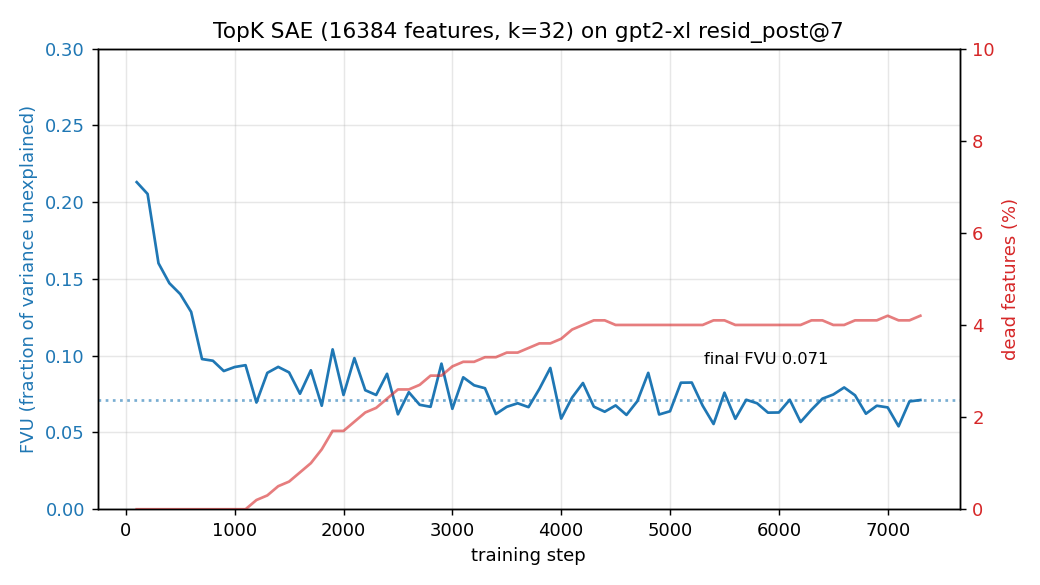
The metric to watch is FVU — fraction of variance unexplained — which is just reconstruction MSE divided by the variance of the data. It fell to ~0.07, meaning the SAE reconstructs ~93% of the residual-stream variance from 32 active features per token. The other line is the dead-feature fraction — latents that stopped firing entirely — which stayed at ~4%. Dead features are the classic SAE failure mode (the dictionary silently shrinks), so keeping it low without any resampling tricks is a good sign that k=32 and the learning rate were in a sane range.
Reading the features
The real test isn’t the loss — it’s whether the latents mean anything. So I streamed fresh OpenWebText through gpt2-xl, encoded each token’s residual with the SAE, and for a set of moderately-sparse features recorded the token contexts where they fired hardest. A sample of what layer 7 had learned:
| feature | fires on | top contexts |
|---|---|---|
| 2693 | the noun after “The” | The activists, The Roman, The Obama |
| 1598 | the noun after “An/A” | An Idaho, An artist, An iPhone |
| 10657 | the last item in a list | Wii, DSi and Kinect; North Korea and Haiti |
| 15353 | sentence onset after a paragraph break | \n\nWhile the, \n\nWhen the |
| 13867 | salient topical nouns | solar, HIV, TCP, emergency |
| 9326 | the � replacement character |
It�, spectacular site,� |
This is roughly what you’d expect from a middle-early layer: a lot of it is syntactic position (“the head noun after a determiner”, “the final element of a coordinated list”, “the first word after a paragraph break”) rather than abstract semantics. That’s a feature, not a bug — it’s the kind of structure layer 7 should be tracking, and it’s legible. And tucked in among the grammar is feature 9326, which fires specifically on �, the Unicode replacement character that shows up when text has a botched encoding. gpt2-xl has apparently allocated a dedicated direction to “this is mojibake.”
Closing the loop: steering
Max-activating contexts only show correlation — feature 9326 lights up near �. The stronger claim is causal: if I clamp that feature on, does the model produce �? This is the same move as Anthropic’s Golden Gate Claude, just at gpt2-xl scale.
Mechanically it’s a forward hook at layer 7 that adds α · (scale · decoder_row[f]) to the residual stream during generation — the decoder row is the feature’s direction in normalized space, and multiplying by the scale puts it back in real residual units. Same prompt, same seed, sweep α:
prompt: "My favorite thing about the weekend is"

[α = 0  baseline]  …that I don't have to be worried about my phone during the weekend.
[α = 10]           …that I don't have to be worried about my phone during the weekend.   (unchanged)
[α = 25]           …that I don't know what I would do with her. But I really feel like…   (drifting)
[α = 40]           …is����������������������������������
There it is. Below a threshold the steer does nothing; push it and coherence degrades; push it past ~40 and the model does nothing but emit �, forever. The feature that correlates with the replacement character causes the replacement character when you force it. Same experiment on the “final item in a list” feature (10657) instead collapses the model into looping short clauses — “We are here. and now. We are here.” — a syntactic feature producing a syntactic pathology, which fits.
I’ll admit I went in hoping for a tidy semantic feature — a “talk about San Francisco” latent — and at layer 7 the vocabulary is more grammatical than thematic, so the cleanest causal demo turned out to be an encoding artifact. That’s honest and, I think, more interesting: the SAE surfaced a direction I’d never have gone looking for, and steering confirmed it does exactly one thing.
What this bought
End to end: a 90 GB activation dataset, a TopK SAE that explains 93% of the residual variance with 32-of-16,384 sparsity and few dead features, a legible catalogue of what a middle-early layer is tracking, and a causal handle on one of those features. The pipeline from the last post made the front half fast and un-lose-able; the SAE made the back half interpretable.
The natural next steps are the interesting ones: run this at a later layer where features get more semantic, look for a genuinely conceptual feature to steer, and measure how much the SAE actually costs the model when you splice its reconstruction back into the forward pass (the “reconstruction fidelity → downstream loss” question). But finding a � neuron and being able to switch it on was a good enough place to stop for today.